Past issues
- 2025
- 2024
- 2023
- 2022
- 2021
- 2020

In this Volume:
- CORRECTING THE ANALYTICAL MESS CURRENT DISCUSSIONS ABOUT DOWNTOWN CRIME ARE IN — by N. David Milder, DANTH, Inc - Oct 27, 2025
Article
CORRECTING THE ANALYTICAL MESS CURRENT DISCUSSIONS ABOUT DOWNTOWN CRIME ARE IN
October 27, 2025
N. David Milder
Abstract
Downtown crime has again become an important concern within the downtown revitalization community as it was back in the 1970s and 1980s. Indeed, the current conditions in our downtowns mirror on several dimensions those present back then. Unfortunately, our current discussions of downtown crime are full of serious errors because they focus on crime rates, when the key casual factor is the strength of the fear of crime among downtown users. As has been know for many decades, these potential causal factors are weakly related to each other.[1]
Also, for too many years the causal path between high fear, weak visitation and reduced downtown activation has mistakenly been seen as High Fear–> Reduced Visitation –> Reduced Activation, while the real causal path is: A Multi-Causal Factor in Which Fear is Just One Element –> Reduced Visitation –> Increased Fear –> Greater Avoidance Behavior –> Reduced Activation. Greater functional diversity can help assure adequate visitation.
Introduction
The Recent Downtown Crime Rollercoaster. In the early years of the powerful socio-economic-health crisis sparked by Covid19 many of our large office worker dependent downtowns became denuded of their brisk pedestrian flows and open street level shops. They looked as if they were hit by neutron bombs. Visitors selling and using drugs, and the homeless who had nowhere else to go became more visible simply because of the decline of the downtown’s normal activities. Often added to this was a reduced police presence, and unwarranted media coverage. The “defund the police” movement resulted in less police and fewer recruits wanting to join the police because of their diminished image. That combined with the citywide shutdowns of many essential social organizations such as schools, colleges, workplaces, rehab centers and other social gathering places made city crime rates shoot upwards. As the crisis waned, despite frequent forecasts of our urban areas becoming more dangerous than ever before, the serious crime rates — FBI Part One rates[2] — dropped noticeably. However, the retail crime rate and many of those on the FBI’s Part Two crime list did not decline and continued to be problematic. Many of those lesser crimes are signs of disorder that can instill the fear of crime.
A 2023 study by Brookings noted that:” Local data on property and violent crimes shows that in New York, Philadelphia, and Chicago, downtowns are some of the safest places to be.”[3] Many downtown stakeholders and officials consequently have grabbed on to those crime rates and see their downtown’s’ crime problems as again manageable. Their returning visitation levels and commercial activity are seen as sufficient to make visitors feel safe, even if they are still somewhat shy of precrisis levels.
The Mirroring of Our Downtowns in the 1980s. The current problem is that the public discussion about downtown crime that seems dominated by crime rates is off target since it is fear that influences how people behave, and thwarting visitation is not how fear harms our downtowns. To shed some light on the importance of downtown fear and how it impairs how our downtowns operate, this article will extensively utilize the data and analysis produced by the Downtown Safety, Security and Economic Development (DSSED) program back in the 1980s that aimed at finding ways to reduce downtown fear.[4] Why reach back to those years and that study? Because both are extremely relevant today. The 1980s experience is remarkably similar to what many of our downtowns have been experiencing since 2020 with empty downtowns, soaring fear of crime, and significant urban unrest. As for the DSSED research, there has been nothing to refute or replace it since then, while discussions about downtown crime continue to wrongly focus on crime rates and their purported strong impact on visitation.
The Crime Rate Mistake. Focusing on crime rates is a mistake because they per se are not what has troubled our downtowns and major urban areas, nor were they the main focus of Jane Jacobs, and Wilson and Kelling when they analyzed the urban crime problem. Back in 1961, Jane Jacobs insightfully wrote: “The bedrock attribute of a successful city district is that a person must feel personally safe and secure on the street among all these strangers. He must not feel automatically menaced by them….”[5]
In their landmark 1982 Broken Windows article, Wilson and Kelling posed an important question: “But how can a neighborhood be ‘safer’ when the crime rate has not gone down—in fact, may have gone up? Finding the answer requires first that we understand what most often frightens people in public places.”[6] The article wasn’t primarily about lowering crime rates but about reducing fear and reinforcing the presence of public order in people’s minds.
For Jacobs, Wilson, and Kelling, fear of crime—not crime rates—was a critical variable in understanding urban decay or resilience.
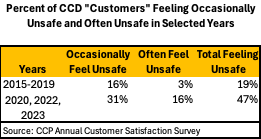 While there is far less data available about downtown fear levels, a survey done by the CCD in Philadelphia suggests that fear levels there – and probably elsewhere — have risen significantly since the onset of Covid. In 2015-2019 only 19% of the CCD’s “customers” felt occasionally or often unsafe, but the averages for 2020, 2022 and 2023 showed 47% of them felt similarly unsafe. More prevalent “signs of disorder”, such as aggressive panhandling, and lack of police presence accounted for this heightened level of fear.
Also, the 2023 report from Brookings argues that: “Whether or not crime actually is up in central city business districts, widespread fear of crime—driven in no small part by relentless media coverage—certainly is.”[7]
That downtowns can be relatively safe places, but still often generate very high levels of fear is a conundrum always faced by downtown leaders when they feel they have a serious crime problem. The media have traditionally reported in ways that reinforced the fear and crime rate disparities.
In the following sections the discussion will explore how crime rates and fear levels differ, and how fear negatively impacts our downtowns.
Key Characteristics of Downtown Crime Rates and Fear Levels.
Many of the following points have been established for decades but are too often forgotten in today’s conversations about downtown crime:
- Downtown crime rates have typically been lower than citywide averages, though significantly this is rarely reported in the media.
- Public perception tends to vastly overestimate downtown crime. For instance, a 1984 survey in Jamaica Center, Queens, found that 50% of trade area residents surveyed believed there were 3 to 7 times more street robberies per day than police data showed.[8] Other studies have revealed similar distortions.
- Fear levels correlate poorly with actual crime! Fear can remain high—or even grow—despite declining crime statistics. The reverse can also happen.[9]
- Community policing is intended to lower fear levels, but… program designs and effectiveness have varied. Their success depends less on the deployment of police personnel than the relationships and trust they build with local residents, workers, businesses and other organizations. Simply deploying patrollers is not real community policing. Though community policing is intended to both build and then build upon increased community trust, it also is less liable to succeed in communities where local folks are fearful of or lack a positive relationship with the local PD. That is simply because such relationship building is far from easy to accomplish.[10] It still remains a major challenge decades after the introduction of the community policing concept.
- Reliable crime statistics are widely available. Fear data are not. In some cases, fear-related data are deliberately withheld because of potential negative impacts on the downtown’s image.
- Because fear metrics are scarce, investors, media commentators, analysts, and policymakers often rely on crime rates as a proxy—despite their limited explanatory power — when it comes to understanding crime’s impacts on visitation, investment, or public confidence.
- People can fear that the crime rate will soar. This was noted in the 2023 Brookings study. However, in my interviews with the locators of office and retail spaces about several downtowns, this fear was also frequently raised. It is an interesting example of a fear that is not in the moment and experientially based, but attached to an idea about probabilities. It is not the crime rate itself, but the fear of it rising that is the critical component. What can be unclear is if the fear is ideational or has an attached experiential or emotional component, or it contains them all.
How Fear Impacts Our Downtowns
Impacts on Visitation. Back in the 1980s I directed for Regional Plan Association, the Downtown Safety, Security and Economic Development program. [11] Many of the local businesspeople and political leaders in these three outer borough downtowns in NYC[12] as well as in the others we contacted across the nation[13] saw the most negative impacts of crime being a severe reduction in how often people visited their downtowns, especially those who were formerly their valued customers. Consequently, in many of the downtowns across the nation we visited or contacted during the project, local leaders were intent on devising anticrime programs aimed at drawing more “traffic” downtown. Yet, the research we did told a somewhat different, and more nuanced story.
Downtowns With Strong Reputations of Being High Crime Areas Were Beehives of Activity During the Day. Our local research included a telephone survey of downtown trade area residents, surveys of their retailers, and numerous group meetings and in person interviews with local police, business, and community leaders. We also spent many hours observing how people behaved at various parts of these downtowns at various times of the day.
Our team visits to the three outer borough downtowns showed they were far from being deserted, unused commercial centers during the day! After visiting these downtowns, a former president of Bloomingdales described them as “beehives of activity,” with substantial pedestrian activity and busy shops. They had major transit stations, colleges, government offices, courts, libraries, and retail shops, among which were some operators with sales PSF that rivaled those in some of Midtown Manhattan’s swanky retail corridors. Many visits to thesedowntowns were born of necessity, because they had the destinations visitors had to go to: transit stations, colleges, courts, government and professional offices, jobs, etc.
One important change that appeared obvious was the churn in the racial and ethnic mix of their daytime populations and business operators. There were far fewer White middle class Irish, Italian, German and Jewish visitors and businesspeople, and far more Blacks and Hispanics than back in the 1950s. These were not three failed downtowns, but ones where the racial and ethnic composition of its visitors and business operators had changed.
Our field observations also found that these downtowns were inert, closed tight after dark, and our survey found that between 62.6% and 65.8% of the residents in the trade areas of these three downtowns felt their downtown was not as safe after dark as other shopping centers they frequented.
Nevertheless, our survey showed that these downtowns were still drawing substantial traffic during the day from their trade areas, while many respondents thought it likely that they would encounter a car being stolen or broken into, 58%, or someone being attacked, beaten or raped, 40%, or a wallet or pursue being stolen, 74%.[14] The survey’s 600 respondents were asked whether they visited their downtowns at least once a week, once a month, once in a while or never. In each trade area only between 20 percent (Brooklyn) and 30 percent (Fordham Road) reported never going to their downtown. And overall among the “visitors”, there was almost an even division between those who visited regularly on a weekly or monthly basis (38 percent) and those who just visited once in a while (37 percent). Considering that no downtown captures visits from 100% of its trade area residents, these numbers cannot be considered as indictors of downtowns where the fear of crime has had a mortally negative impact on their visitation.
The vast majority of those from households with annual incomes in excess of $25,000 (about $76,800 in 2025 dollars) visited their downtowns, although trade area residents with lower incomes were more likely to be visitors and to visit more often. These downtowns may have become more racially and ethnically diverse, but they were still attracting lots of solidly middle-income visitors.
That raised the critical question of how, then, did the fear of crime injure these downtowns? The survey asked respondents: Compared to other commercial centers you usually shop in would shopping during the day in downtown X be safer, about as safe, or less safe? When correlated with how often respondents visited their downtowns, it proved to be the strongest variable, with a statistically significant Pearson Correlation of .30. That suggested that the fear of crime indeed had a significant negative impact on the visitation to these downtowns. However, it was not strong enough to account for most of the variation in trade area resident visitation.
A stepwise regression analysis was then done with a dependent variable that divided respondents into those who visited the downtown and those who did not. Here the daytime safety variable had a relatively weak but statistically significant relationship, apparently being a meaningful contributing reason, among others, for the 20% to 30% of trade area residents to never visit their downtowns. Other influential variables impacting whether trade area residents visited or did not visit their downtowns were downtown attractiveness, merchandise quality and race. Together these three variables explained more of the statistical variance than the fear variable. This is a very important point when we consider what was happening in these three downtowns back in the 1980s and what probably was happening recently in our larger downtowns across the nation. Downtown visitation was impacted by fear, but it was only one of several factors that were influencing whether or not people were coming downtown, among which none stood out as being dominantly strong.
These totally non-visitors were not being influenced by a current in the moment downtown experience, though they probably were responding to either memories of earlier experiences there, or negative safety messages they have received about downtowns in general or the downtown close to them in particular.
Then we also analyzed separately the 70% to 80% of the trade areas’ residents who did visit their downtown to determine how daytime safety impacted on how often they visited. Among these visitors downtown safety did not have any significant correlation with how often they visited. Other factors such as ease of trip and the downtown’s attractiveness were more powerful influences on the frequency of their visits.
As noted above, the survey asked respondents how likely they felt someone visiting their downtown would encounter an attack or rape, street robberies or car theft. A statistical analysis showed that these perceptions had little or no correlation with downtown visitation, though they did have significant correlations with general feelings of downtown safety.
These findings support the conclusion that for these three downtowns the fear of crime/concerns about safety did not have strong impacts on the visitation rates of most trade area residents who visited their downtowns. It did have some impact on those who never visited their downtowns, along with several other variables. Fear of crime certainly was not benign, but it did not appear to be a singular and strongly disrupting influence on visitation.
Fear, Avoidance Behaviors, and the Multiplier Effect. If fear was not harming downtown visitation as uniquely and strongly as so many downtown leaders and stakeholders believed, then how was fear effecting its negative impacts? Our trade area survey did not provide the answer. Instead, that came from a combination of field observations, some other research, and some programs adopted by downtown organizations around the country. We concluded that the primary negative impact of fear is not on visitation, not about those who do not visit the downtown or visit less often, but on how visitors behaved once they got there. They engage in a lot of avoidance behaviors such as not visiting after dark, and not going into many parts of the downtown, or only visiting them at certain times of the day, or only with other people accompanying them. For instance, our survey found that nighttime fear levels were much higher than daytime levels, a finding that several other studies of other downtowns also found. Pedestrian traffic in these downtowns strongly reflected that. Our field observations found considerable “five o’clock flight” among their office workers. A study of a park in Jamacia Center found that 54% of the downtown’s office workers avoided it during the day because of drug dealing and use there.[15] As part of the project, we also studied the use of Bryant Park in Midtown Manhattan, already known for its drug use and sale. We found that office workers at lunch time would often use the sunny parts of the park where they tended to cluster, while the drug activities were found in the shaded and less visible parts of the park that were hidden by shrubbery. Nationally, research showed that women often avoided using downtown parking garages, and many downtown organizations and building mangers had created escort services to keep downtown workers feeling safe when they went to their cars at the end of a workday, or tenants provided car services to take their employees home after dark. The internal commercial networks in places like Houston and Charlotte were meant to provide protections from unpleasant weather conditions, but also safer environments.
Because of their multifunctionality and compact areas downtowns usually have a very strong competitive advantage over other commercial areas: a strong propensity to generate numerous multi-use, multi destination visits. Confirmation of the import of such visits has been provided by the town centers and other more functionally diverse shopping centers that recently have been developed across the US. We called this the downtown multiplier effect. When downtown visitors engage in lots of avoidance behavior that weakens the multiplier effect: it can decrease the number of visitor pedestrian trips, dwell times and the number of destinations visited. That is how fear primarily disrupted how these downtowns worked. Fear changed the ways visitors behaved downtown, but had less impact on discouraging people from visiting.
How do these findings hold up today? Covid created an immense crisis, one that is unrivaled since the Great Depression. It created a fear loaded environment with anxieties about personal and family health, jobs, safely getting food and medicines, etc., while social support mechanisms either closed or had reduced availability, e.g., schools, workplaces, churches, etc. For many the empty streets and closed shops were strange, and never seen before. Existing fears facilitated having new fears. That downtown fear levels soared should not have been surprising!! It would have been more surprising if they did not rise.
In downtowns where visitation has returned to around 80%+ of pre-crisis levels,[16] the causal paths we identified back in the 1980s can be expected to return. The best confirmation of this would be that downtown visitors are engaging in low levels of avoidance behaviors.
However, in the downtowns where such visitation is absent, the casual paths today are more complicated. First, is the reduced visits by downtown workers who are working much more at home. Then there are the closed or weakened shops. Such low activation cannot heal visitor fears. High levels of avoidance behavior can be expected, and would indicate that fear is still an important factor. Indeed, measures of avoidance behavior — e.g., usage counts, survey reports – are probably the best indicators of how safe a downtown really is.
Action Implications
For too many years the causal path between fear, visitation and downtown activation has mistakenly been seen as High Fear–> Reduced Visitation –> Reduced Activation, while the real causal path is A Multi-Causal Factor Among Which Fear is Just One Component[17] –> Reduced Visitation –> Increased Fear –> Greater Avoidance Behavior –> Reduced Activation.
The tools that downtowns used in the 1990s to successfully reduce fear levels are very likely to again be successful today where similar conditions exist. The most important objective is to get downtown sidewalks and public spaces properly activated. That means their having sufficient pedestrian traffic and activities to make people feel save. Hordes of pedestrians are not needed, just enough of them, though more is better than less.
The presence of the same police patrollers and BID ambassadors who interact with downtown visitors can help cultivate such activation. However, too strong a presence can be read by visitors as a sign that the area is not safe. (Why else would so many security personnel be needed?)
While fear may not have a strong impact on downtown visitation levels, to succeed downtowns need strong visitation levels. The activation of our downtowns to the level needed to meaningfully reduce fear levels will depend strongly on their ability to have significantly more viable functional diversity to provide that visitation.
The reduced numbers and attendance of office workers, for example, probably makes the activation of the sidewalk’s near their buildings more difficult. That will be especially true if office tenants provide strong amenities, such as free or subsidized on site lunches, etc. Large corporations often try to keep their office workers in their buildings as much as possible. Other uses will be needed to provide the pedestrian activity that was lost by the diminished office worker presence.
The visits of downtown residents have proved to rebound to pre Covid levels better than those of non-resident downtown workers or visitors from outside of the district.[18] Their numbers have been growing and many cities, e.g., Chicago and NYC, are trying to attract large numbers of new residents to their downtowns.
ENDNOTES
[1] See: Milder, N. David. “Crime and downtown revitalization.” Urban Land 46.9 (1987): 16-19 https://www.ndavidmilder.com/wp-content/uploads/2012/05/dt_crime_article.pdf
[2] Part One Crimes: criminal homicide, forcible rape, robbery, aggravated assault, burglary, larceny theft, grand theft auto, arson. Part Two: forgery, fraud and NSF checks, sex offenses felonies, sex offenses misdemeanors. non-aggravated assaults, weapon laws, offenses against family, narcotics, liquor laws, drunk / alcohol / drugs, disorderly conduct, vagrancy, gambling, drunk driving vehicle / boat, vehicle / boating laws, vandalism, warrants. receiving stolen property, federal offenses w/o money, federal offenses with money, felonies miscellaneous, misdemeanors miscellaneous. Many of the Part Two crimes are also perceived by the public as signs of public disorder, and result in higher levels of fear of becoming a crime victim.
[3] Hanna Love and Tracy Hadden Loh. “The geography of crime in four U.S. cities: Perceptions and reality.” Brookings, April 3, 2023, https://www.brookings.edu/articles/the-geography-of-crime-in-four-u-s-cities-perceptions-and-reality/
[4] See: Endnote 1
[5] Jacobs, Jane. The Death and Life of Great American Cities. Random House, 1961.
[6] Wilson, J. Q., & Kelling, G. L. (1982). Broken Windows. The Atlantic Monthly, 249, 29-38.
[7] See Footnote 3.
[8] N. David Milder. “Reducing the Fear of Downtown Crime: The Executive Summary of the Final Report.” Regional Plan Association. 1987. Hereafter referred to as the DSSED. https://www.ojp.gov/ncjrs/virtual-library/abstracts/reducing-fear-downtown-crime-executive-summary-final-report#:~:text=The%20research%20also%20indicates%20that,a%20downtown%20area%20can%20occur
[9] See the discussion of this in Endnote 1’s reference
[10] This is the first of many studies establishing the importance of relationship building for community policing: Trojanowicz, Robert. et al. An Evaluation of the Neighborhood Foot Patrol in Flint, Michigan. Michigan State University, A Manual for the Establishment and Operation of a Foot Patrol Program. Michigan State University, 1984. A recent blog post that gets into the challenge of such relationship building is: Dimitrios Mastoras, “The Need for Relationship-Based Policing,” On Policing Blog, Feb 10, 2023 https://www.policinginstitute.org/onpolicing/the-need-for-relationship-based-policing/
[11] It was a project of the Regional Plan Association funded by three grants from the National Institute of Justice and donations by many large corporations headquartered in NYC, largely banks and real estate related organizations, but also firms such as Time Inc, TIAA, Metropolitan Life and Pfizer. The Citizens Crime Comision of NYC partnered with us in the first phases of the project. The boards of both organizations were filled with high level executives from large corporations, and the DSSED’s Project Steering Committee was drawn from them.
[12] The NYC downtowns were Downtown Brooklyn, Jamaica Center in Queens and the Fordham Rd district in the Bronx.
[13] Our search for solutions was nationwide and included in-person or telephone interviews with local leaders in Atlanta, Cincinnati, Charlotte, Chicago, Cleveland, Denver, Hartford, Houston, Los Angeles, Miami, Minneapolis, Newark, New Orleans, Oakland, Orlando, Philadelphia, Portland, San Francisco, Seattle, Stamford, Tulsa, and Washington DC.
[14] Milder, N. David, and Scott Veale. “Downtown Safety Security and Economic Development.” New York: Downtown Research and Development Center (1985): pp.141.
[15] Vernon Boggs, “King Park and Manor Users Study.” Cooperative Research Unit, CUNY Graduate School, 1984, p. 23.
[16] Re these downtowns see: Paul Levy, Center City District. “Downtowns Rebound: The Data Driven Path To Recovery.” Oct 5, 2023. https://centercityphila.org/downtownsreport
[17] Strong attractions/destinations can attract visitors even to areas seen as having a lot of crime. Districts that people find easy to get to, attractive, and filled with people like them as well as thing they like or need to do will draw substantial numbers of visits even if they have a high crime reputation.
[18] See Endnote 15.