Article
RETHINKING THE THINKING ABOUT DOWNTOWN CULTURE/ARTS/ENTERTAINMENT DISTRICTS … and for that matter, all kinds of downtown monofunctional districts
June 11, 2024
N. David Milder, DANTH, Inc.
INTRODUCTION
Over the past decade my work on Central Social Districts (CSDs), downtown arts districts, and 15 minute communities has led me to time and again see the weaknesses in using districts as the key geographic unit of analysis. For instance, I concluded that because the CBDs and CSDs refer to overlapping or the same areas in a downtown, it is better to just use the terms downtown, Central Business Functions, and Central Social Functions.[1] Of course, despite that effort, the use of the term, especially its CBD variant, persists and the downtown itself and some of its subareas such as its theater or major office clusters are all referred to as districts. Consequently, though work-arounds are possible, analysts seldom give the district concept the analytic attention it requires since they seem to wrongly assume the concept’s meaning, and proper applications and definitions are well known and humdrum.
However, as a result of the serious problems many downtown office clusters are facing, the value or tolerance of monofunctional districts has lost considerable favor, and many downtowns are rushing to increase their functional diversity. At the same time, with the increasing recovery of our downtown culture/arts/entertainment (CAE) venues and the increased drive for more functional diversity, one might anticipate that growing CAE assets will be a frequent goal, and using CAE designated downtown districts will be a frequent tool for achieving it. Consequently, it is of growing importance to have a proper understanding of downtown functional districts.
That said, I want to be clear that I am not calling into question the use of the term district when applied to municipally designated downtown assessment areas, i.e., business improvement districts.
A reviewer of an earlier draft of this article noted that I provocatively raised more issues than I resolved. That pleased me since I hope this article provokes others to think seriously about downtowns, their clusters and districts, and the need to achieve functional diversity.
DOWNTOWN MULTIFUNCTIONALITY WAS OFTEN THE RESULT OF A LOT OF SUB-DOWNTOWN MONOFUNCTIONALITY.
The very names of many of our downtown districts indicates what makes them so problematical: e.g. the central business district, the theater district, stamp district, furniture district, antiques district, flower district, diamond/jewelry district, the garment district, the arts district, the financial district, Chinatown, etc. All of these names denote the presence of one very dominant use/function, and while these districts probably have some other uses present, they only play supportive roles by serving those who work and visit the venues associated with the district’s dominant use. A tell of these supportive functions in our large downtowns is that they seldom draw meaningful customer traffic from areas beyond about a five-minute walk from their locations.
There is a very good reason that the district concept has had such a long and largely unquestioned standing and use among those who analyze and mange our downtowns: for many decades our downtowns were an aggregation of several of these monofunctional districts. For example, there were reportedly well over a hundred of them in Manhattan decades ago. Office buildings were far from the only use that developed into monofunctional clusters. The multifunctionality that observers often noted as a defining characteristic of our downtowns was regularly mainly the result of a lot of monofunctionality at the subdowntown level! It is important to note that the monofunctional downtown districts of yore are generally more properly referred to as unorganized clusters of venues, each associated with a particular use/function.
DESIGNATED ARTS DISTRICTS
Most of these downtown monofunctional districts were the product of organic growth resulting from a downtown neighborhood having congenial locational assets for a particular use/function. Others were the result of the planned construction of several buildings focused on meeting the needs of a particular group of users, such as the World Trade Center focusing on office uses and Lincoln Center being built as a major Performing Arts Center. Others were the result of a municipality “designating” an area in the downtown or elsewhere in the city as a special place for a particular use/function for non-health or safety reasons, but to support and incentivize the marketing and growth of that particular use/function. Such designations may provide favorable zoning, but the incentives offered often go beyond that if they are properly designed and organized.
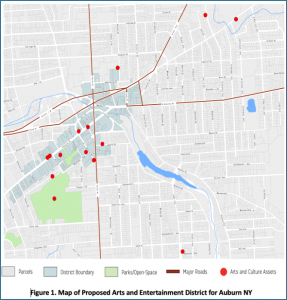 While many of these downtown monofunctional districts have disappeared, for reasons that will be discussed below, pre-Covid19 there was a significant movement to create new CAE districts in communities across the nation that were meant to support the marketing efforts and growth of CAE venues in particular areas in or near a downtown. Such “designations” often are geographically defined to include important existing CAE venues (see Figure 1) and meant to make them stronger, while attracting new ones. However, such geographic designations are often problematical. Many arts districts fail to include all or even most of a city’s arts venues. Also, the prior organic development of these CAE venues is often quite dispersed (see Figure 1), challenging any connotation of their interacting with each other that the term district might have. More about that below.
These efforts to create designated CAE districts tended to be led by those who believed that the arts can be a very powerful engine for economic growth, and was backed by such organizations as Americans for the Arts that advocated for creating culture districts. Some impressive headway was made in a few states, such as the development of 30 “Creative Districts” in Colorado between 2011 and 2024. On the other hand, a master plan for the creation of downtown arts districts in five Central NY cities — Auburn, Cortland, Oneida, Oswego, and Syracuse — published in 2019 has not moved forward. The Covid19 Crisis obviously probably had something to do with that, but how much is uncertain. That crisis probably also influenced Americans for the Arts to stop researching and marketing its culture districts concept, though it seems open to doing so should ample interest and demand return.
AS DOWNTOWN CAE VENUES RECOVER WILL THE MOVEMENT TO DESIGNATE MORE CAE DISTRICTS ALSO REBOUND?
Strong evidence suggests that the recovery of CAE venues in or near our downtowns has been surprisingly robust, if not yet complete. For example, as I have noted in another article, major museums and the Broadway theaters in Manhattan have recovered about 80% of their pre-crisis audiences, a figure that is bound to rise as foreign and business tourist visitors return in the near future.[2]
CAE venues in several other large downtowns have reported similar or even stronger audience recoveries. For example, the recovery of CAE venues in Downtown Los Angeles has been strong and its management is now planning to create a formal Grand Avenue Culture District–and for reasons that suggest that as our downtown arts organizations rebound, creating more downtown CAE districts will again attract supporters. This is how Nick Griffin, the Executive Director of the DTLA Alliance has summed up the current strategic importance of his downtown’s CAE functions: “The fact that the expansions of The Broad and The Colburn School are both based on demonstrable demand – growing student body and 500+ annual performances at Colburn and The Broad blowing their attendance projections out of the water by almost 4x within the first few years – speaks to the strength and appeal of Grand Avenue’s cultural institutions, and while they certainly took a hit during the pandemic, they are not only recovering well, they are positioned to play a key role in the reimagination of DTLA in the context of shifts in the office sector and growth in residential and hospitality…. I’ll note that our long-envisioned dream of creating a formal Grand Avenue Cultural District is finally taking shape, with funding in place and a kick-off planning meeting scheduled for next week!”[3]
TO READ MORE CLICK HERE
[1] N. David Milder. “A Search for a Clearer and More Useful Vocabulary for Talking About and Analyzing Downtowns.” Downtown Curmudgeon Blog, December 14, 2021 https://www.ndavidmilder.com/2021/12/a-search-for-a-clearer-and-more-useful-vocabulary-for-talking-about-and-analyzing-downtowns.
[2] N. David Milder. “Let’s Recognize And Leverage The Opportunities The Covid Crisis Has Given Our Downtowns.” Economic Development Journal, 2022, p34 https://www.dropbox.com/s/v9v5y0ovtxzlkco/Milder%20leverage%20crisis%20produced%20opportunities%20EDJ_Fall2022_final.pdf?e=1&dl=0.
[3] In an email communication.