Article
The Current Status of Art Museums as Possible Downtown CSF Foundation Stones
April 4, 2026
N. David Milder. DANTH, Inc.
Abstract. Our large downtowns, with a few exceptions, are facing shrinking office clusters and a need to become much more functionally diverse. AI threatens to further diminish these office clusters. Strengthening a downtown’s Central Social Functions (CSFs) is a way that these downtowns can maintain their activation, magnetism, social centrality of place, safety, business attraction, and property values. Housing is currently cited most often as a way to add such diversity. Which other CSF functions can help assure adequate visitation is an increasingly important strategic question. The arts and entertainment are cited as possibilities. This article looks at art museums’ ability to play a CSF foundation stone role by providing the downtowns they are in or near with, at a minimum, a steady flow of a significant amount of visitors, with a possibility of future growth. Since these museums share a number of challenges in maintaining and growing their audiences with many other types of arts venues, the findings of this article may have wider applications.
Introduction. The focus of this article is on arts museums in our larger downtown, those that are likely to have large office clusters and looking to become more functionally diverse. Art museums were selected because dealing with all of the arts sectors would be a project requiring unaffordable amounts of time, staff and money, while the museums are in at least 23 of our 27 largest downtowns,[1] and their audience retention and growth challenges are shared with many other arts sectors.
The article’s objective is to investigate the ability of arts museums to be Central Social Function foundation stones. As our larger downtowns aim to become more functionally diverse by growing their Central Social Functions (CSFs) , the question of which of them besides housing can support or lead that growth becomes germane. Our downtowns will need CSF foundation stones that have a solid, reliable ability to attract lots of visitors, lengthen visit dwell times, provide customers for downtown merchants, and have positive impacts on property values. Hopefully, they also will have the potential for future growth or their presence being leveraged for the growth of other nearby attractions. Minimally, they should provide a steady significant flow of visitors.
One reason for the selection of downtown art museums is that several of them attract 800,000+ visitors a year even though they have not fully rebounded to their 2019 levels. Another is simply the availability of useful data. That is not to say that the available data meet the most rigorous standards for validity, reliability and saliency, but that they are good enough to paint an informative picture of the current strengths and weakness of art museums in and near their downtowns. In turn, that will enable a reasonable assessment of their ability to be CSF foundation stones.
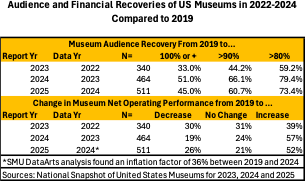 Museums in General. According to research done for the American Alliance of Museums, by 2024: “Over half (55%) of U.S. museums have not returned to pre-pandemic attendance” and 81% is the “ median pre-pandemic attendance levels for those 55% of museums.”[2] That means that 45% had fully rebounded. About 60% had recovered 90%+ of the 2019 admissions level, and about 73% had recovered to an 80%+ level. See table on left. Museums with mid-sized operating expenses between $125,001and $1 million report higher attendance rates than those of the museums with smaller and larger budgets. While 2023 saw 51% of the museums reporting that their audiences had recovered or surpassed their 2019 levels, 2024 saw that fall back to the 45% level. Of considerable concern is that 29% of museums reported their attendance fell in 2024 because of changes to travel and tourism and/or economic uncertainty. This downturn seems independent of the causal nexus associated with the Covid19 crisis or the one that has caused concern about arts audience shrinkage since 2008. The decline in tourism is no longer based on disease threats and responses, but on domestic economic issues, and national policies towards foreign nations such as tariffs and visa availability.
Financially, museums also took another hit in 2024. Finances have an important tie to recovering past visitation levels. Free admissions and more attractive offerings are key tactics for increasing visitation, and they are hard to do if the museum is in financial trouble.
In 2023, 57% percent of museums reported their net operating performance had improved compared to 2019, higher than the 52% in 2024. Reports of declining performance rose from 19% in 2023 to 26% in 2024. This indicates that 2024 was a more financially stressful year for museums than 2023, though still better than 2022.
In comparison, attendance at 74% of the nation’s opera companies – once the attendance basket case of the arts industry — had rebounded by the 2022-2023 season to their 2019 levels, and the attendance for Broadway shows during the 2024-2025 season equaled 99.6% of the record breaking 2018-2019 season. Symphony orchestras last year sold tickets at roughly prepandemic levels. In contrast, regional theaters have been facing tough times. There were some initial signs of recovery from Covid but from 2023 to 2024, regional theater attendance fell again, by 19%, and incomes fell by 37%.[3] That both the museums and the regional theaters had declining audiences and incomes suggests that by 2024 non-Covid related factors were adversely affecting many arts organizations large and small.
Going to a movie theaters was once a weekly habit for most Americans, but they have been under threat ever since TVs became a household necessity. Shifting showings to TV and computer screens from theaters has been on the table since at least 2008. Covid-19 did not initiate the severe problems the movie production industry and its theaters faced but it sure accentuated them. Today there are fewer big screens in the United States, 35,481, than before the pandemic 41,172. Admissions last year were off 2019 numbers by 38%, and box office receipts dropped by 23%.
Importantly, across the spectrum of arts venues, even when audiences are returning, observers report things are just different from the prepandemic days. That may include soaring production costs, changing audience tastes, shorter performance schedules, etc.
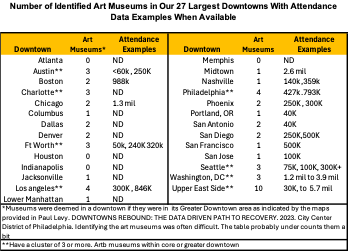 Identified Art Museums in our 27 Largest Downtowns. The nearby table provides some data on the number of art museums in each of our 27 largest downtowns, along with some found examples of reported visitation stats. It should be treated as having heuristic value rather than being definitive since some smaller museums may have been missed, and those with just some arts holdings were not included. In several instances the data on visitation are from pre-Covid years. They are included because they still give a general indication of the visitation level: 30K to 100K are not likely to soon be 1 million plus. 30,000 is the visitation level of the art museum in downtown Cedar Rapids, Iowa, a city with a population of about 137,000. Those low visitation numbers can be usefully thought of as an ordinal measurement such as “low” or “modest.” Readers can convert the other numbers into their own ordinal measures.
A very important point: there are several art museums that were counted for the above table that have middling attendance numbers in the 250K to 800,000 range, but are widely well regarded for their outstanding holdings. That and their prestige are valuable growth assets. However, the appealing character of some of these museums, such as the Frick and Neue Galerie in Manhattan, and the Barnes in Philadelphia, are tied to their buildings and the limited but prized holdings they have. That probably constrains their potential for in person audience growth.
Our search found art museums in 23 of the 27 largest downtowns, either in their core areas or in the greater downtown areas. In some instances, such as Houston, there are numerous art museums in the city but in distant arts/cultural districts.
A total of 55 art museums were identified. In Austin, Charlotte, Ft Worth, Los Angeles, Philadelphia, Seattle, Washington DC and the Upper East Side three or more art museums are clustered within a reasonable walking distance of each other.[4] In Ft Worth and LA they are in culture districts. In Charlotte they all are in the Levine Center for the Arts. In DC, they are all affiliated with the Smithsonian.
[1] Paul Levy in his research on rebounding downtowns looks at the 26 largest. I have added the Upper East Side in Manhattan to his list of the largest downtowns. In this paper when there are only data for the 26 downtowns I will use that number; when there is also data for the 27th I will use 27. N. David Milder, “Using different models to understand downtowns in the US.” JURR forthcoming Summer 2026. Levy, P. (2023), ‘Downtowns Rebound: The Data Driven Path to Recovery’, Center City District (CCD), available at
https://centercityphila.org/downtownsreport
[2] Wilkening Consulting. “ Museum Visitation: Demographics of U.S. Museum-Goers: A 2025 Annual Survey Of Museum-Goers Data Story Update” https://wilkeningconsulting.com/demographics-2025/
[3] The New York Times. “5 Years After Covid Closed the Theaters, Audiences Are Returning.” https://www.nytimes.com/2025/03/12/arts/covid-five-year-anniversary-theater-music-art.html#:~:text=
[4] I recognize that I may have missed some art museums and welcome additions and corrections. For instance, I decided that the Whitney was too far from the Lower Manhattan downtown to be associated with it, but I am far from certain about that decision.