Article
From Dangerous to Destination in 30 Days: 6 Steps to Creating Safer Spaces
September 6, 2026
By Max Musicant of The Musicant Group and Joanna Mieleszko.
Editor’s Note: This article was previously published on Practice of Place Substack
With a real-world example about how to actually make a place safer, this article details what it takes to turn a place with a reputation for being dangerous into somewhere people actually want to spend time. This was the central objective that defined our work at Kellogg Mall Park, in Downtown St. Paul – a project that illustrates our 6-step approach to creating safe spaces that we’ll unpack in this post:
6 Steps to Creating Safe Spaces
- Start with a goal not a grievance
- Couple invitation with accountability
- Consistency of care
- Create reasons to be there
- Communicate positive shift
- Collect data that delivers
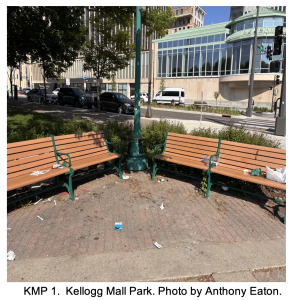 Kellogg Mall Park had a lot going for it: an accessible downtown location, river views, and a beautiful tree canopy. But it also had a longstanding reputation for being unsafe, for visible drug use and homelessness, and as downtown struggled with vacancies and declining activity, the park became a microcosm of those broader problems. Questions about public safety, economic vitality, and the future of downtown basically all converged at Kellogg. There was a genuine fear that the park and its periphery were “doomed.”
So, how do you buck the trend?
It’s tempting to think the answer lies somewhere exclusively within increased enforcement. That removing the people causing problems, increasing police presece, and “cleaning things up” is enough to make a place safe and even attractive. But safety in public space is a bit more complicated.
Consider that a place can be technically free of obvious threats and still feel unsafe, neglected, and uncomfortable. We see it all the time. And when that happens, a negative causal cycle can take hold:
The area is perceived as being unsafe —>
Those that don’t have to be there, stop coming—>
Less people visit the area —>
Businesses suffer from lower sales, employee retention challenges, and higher security and crisis-response costs —>
The fewer people in the area, the more it becomes a haven for negative behavior.
Breaking that cycle requires more than simply trying to stop what’s been identified as “wrong.” It requires creating the conditions for something better that replaces what we don’t like.
Here are six steps for doing just that.
1. Start with a goal, not a grievance
The Trap: When you organize around a problem–there’s too much litter, people are using drugs here, teenagers or some other “undesirables” are taking over the park–the only question becomes: How do we get rid of the problem?
But getting rid of something isn’t the same thing as creating a successful place. Take the concern that “teenagers are taking over the park.” What would success actually look like? A park without teenagers? Probably not.
Most people would probably describe success as a park where teenagers, children, families, office workers, older adults, and really anyone can comfortably spend time. The goal isn’t the absence of teenagers, but a positive experience for everyone who wants to be there.
It’s worth making this distinction because people make different decisions when they’re pursuing an aspiration rather than fighting a threat. Put another way, a park designed around avoiding a problem will produce very different outcomes than a park designed around creating a welcoming public space. This is why uniting around a goal, rather than a grievance, is also step one in our guide to transforming a place when you don’t have all the money or authority.
n the case of Kellogg Mall Park, this approach was put to the test when the St. Paul Parks Department brought on The Musicant Group to turn around the troubled space. We launched a pilot, Kick it at Kellogg, wherein we focused on cultivation rather than elimination. Our engagement process revealed three goals:
- Improve the experience of people in the parks themselves
- Attract more people to visit and enjoy the park on a regular basis
- Do so in a way that accelerates the economic activity and conditions of Downtown
2. Lead with invitation, but create accountability
The Trap: The false choice between pushing out “undesirables” and “anything goes.”
 With any public space, the goal is to communicate: Everyone is welcome, but not every behavior is. Setting expectations for behavior is fundamentally different from deciding which kinds of people belong in a space. One establishes a shared standard; the other risks turning “safety” into a euphemism for profiling.
But creating that standard also means thinking very carefully about how we respond when something goes wrong. Not every problem requires the same level of intervention. Someone leaving trash behind, someone behaving disruptively, and someone posing an immediate threat are three very different situations–and treating all three with uniform accommodation (waving them off) or as emergencies (immediately calling the police) can make a public space feel more hostile without necessarily making it safer.
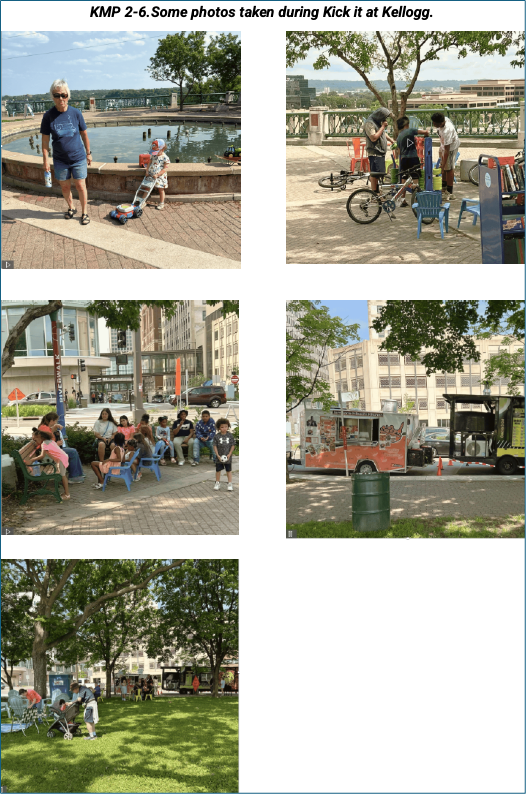
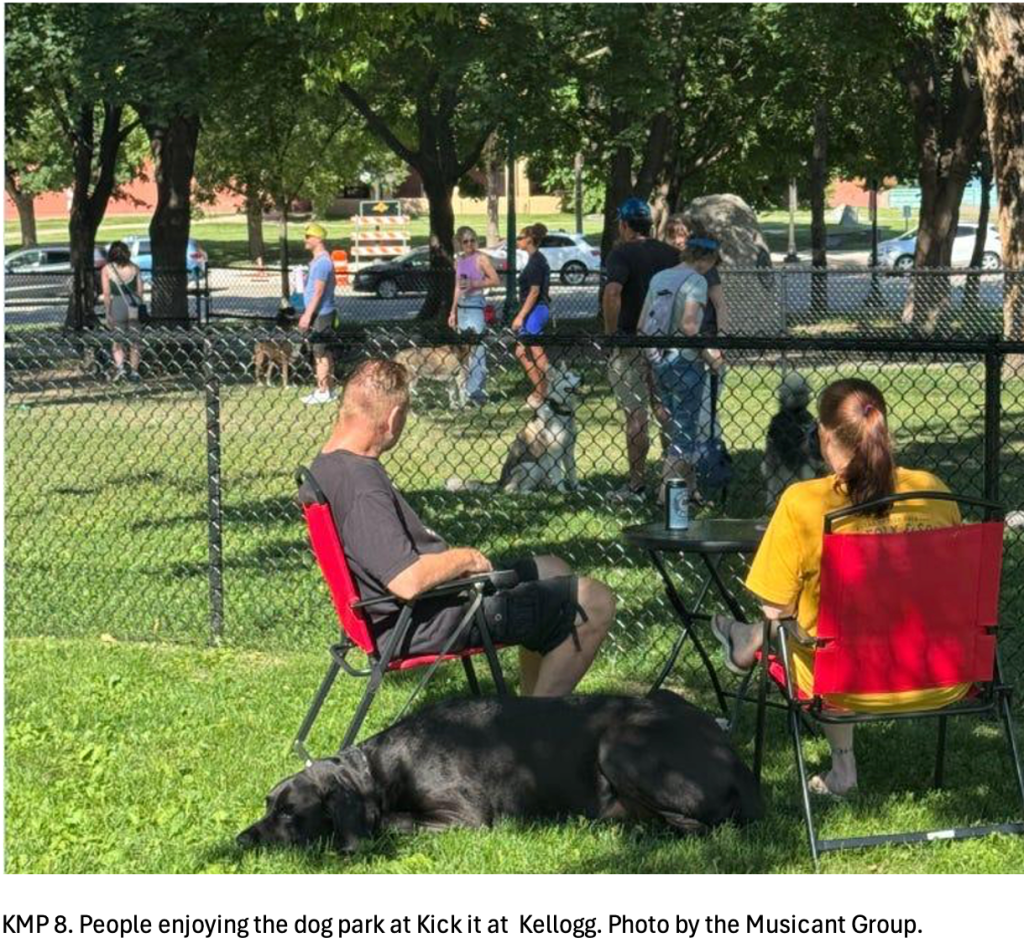
Kick it at Kellogg approached this from two ends. The pilot created a baseline of ordinary activity by giving people reasons to use the park: a dog park, children’s programming, food trucks, and events brought different groups into the space and gave them reasons to keep coming back.
This laid the foundation for what Jane Jacobs famously called “eyes on the street”: the everyday presence of people using a place, watching what’s happening, and informally looking out for one another.
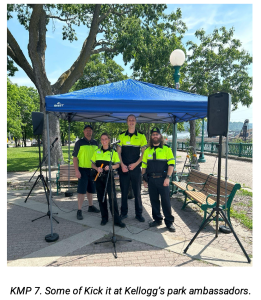 But at Kellogg, there were also people whose job was to help care for the space: park ambassadors.
The park ambassadors were something between a host and a caretaker, talking to visitors, tidying the space, and simply building relationships with the space and the people who used it. They essentially monitored the space, but also established a sense of care and familiarity. When something went wrong, they could often address it at a lower level, before it became a bigger problem. This is key.
“I live downtown with my husband. Your ambassador John in Kellogg Park is amazing. It’s great to be able to walk through Kellogg Park now and not feel unsafe or disappointed because of people using drugs, littering, etc. The presence of ambassadors and police has made a huge difference and all the new activities too.”
A safe public space needs ways to respond to problems, but those responses don’t all need to look like enforcement. A police presence can communicate that a place is dangerous (“why are police needed here?”) or that you’re being watched, whereas a park ambassador who knows your name, picks up the trash beside you, helps you find a replacement for the missing ping pong ball, and, if it’s necessary, escalates to the police, sends a very different signal. The point isn’t that police have no role to play, but that they shouldn’t have to be the only visible response to every problem.
What became clear throughout the duration of the pilot is that these two forms of presence–people who choose to be there and people whose job is to care for the space–created a much stronger foundation for safety than enforcement would have on its own.
3. Consistency of Care
The Trap: Treating the care of a place as separate from its safety.
Making a place actually safer and feel safer means not just ensuring that no negative events occur, but that the environment feels pleasant and communicates that it is cared for. That means going beyond basic maintenance, and yes, it may mean more frequent cleaning, quicker repairs, more attention to landscaping, more flowers, more color, and more people visibly taking care of the space, at least for some time.
Litter, broken furniture that hasn’t been addressed in months, overflowing trash cans, and uninspired landscaping all communicate that nobody is paying attention. But when people regularly see someone sweeping and tending the gardens, they’re seeing care. And that care is contagious.
People who see a place being cared for are more likely to treat it as a place worth caring about. At Kellogg, the park ambassadors were crucial to this calculus. We even saw that people began picking up their own litter when they saw the park ambassadors doing so. That’s how you start replacing an old reputation with a new one.
4. Create reasons to be there
The Trap: Only focusing on what you want to keep out instead of what you want to bring in. Another big part of the Kellogg pilot was simply giving people more reasons to spend time in the park. But we weren’t just adding things for the sake of adding them. Each intervention either brought a new group of people into the park or made it more useful for people who were already using it.The little free library and children’s programming, for example, brought children and their parents intothe park–and kept them there for hours. That’s particularly significant when you’re trying to change perceptions of safety as parents are unlikely to keep bringing their children to a place they consider fundamentally unsafe. Their presence therefore became both a measure of changing perceptions and a contributor to that change.Food trucks gave nearby workers a reason to leave their offices during lunch, while also bringing in people who might not otherwise have had a reason to visit the park. The dog park brought in, well, dog owners. But its value went beyond giving people somewhere to take their dogs. Dogs need to be walked every day, which meant the dog park created a steady stream of regular users and gave the park a baseline level of occupancy even when nothing else was happening.
And then there was movable seating. Rather than deciding in advance where everyone should sit, the park gave people the ability to arrange the space around their own needs. Maybe you wanted to sit in the shade. Maybe you wanted some sun. Maybe an event was happening in one part of the park, or there was an activity or person you simply did not want to sit beside. With movable chairs, you weren’t stuck with whatever arrangement the permanent infrastructure had dictated.
Taken together, these interventions made the park useful to different groups of people at different times of day and for different reasons. And importantly, because this was a pilot, virtually all of them were relatively inexpensive and easy to change. The Kellogg team could add something, watch how people used it, and adjust rather than committing to a costly permanent redesign from the outset.
Positive activity drives out negative activity. The more there is to do, the more people will come and stay and the less those that want to do negative things want to be there.
5. Communicate the positive shift
The Trap: People don’t know what you don’t tell them.
By this point, the physical experience of the park may have changed considerably, but if you haven’t made the trip, how would you know that?
When you’re trying to turn around a place with a bad reputation, that’s a real problem. The stories we tell have a huge impact on how we experience a place.
That’s why for Kellogg, communication became just as important as any intervention on the ground.
https://www.instagram.com/p/DMLDt2YsUwT/
The pilot launched a new “Kick it at Kellogg” brand and with it, its own website, Instagram and newsletter, through which the public learned of events and programming. Meanwhile partner organizations promoted activities through their own networks. A local bookstore, for example, began telling its customers about things happening in the park. Beyond being additional advertising, their word was a vote of confidence. With every promotion, the bookstore was saying, “this is a place we’re willing to associate with, and one at which we feel you’ll have a good time.”
https://www.instagram.com/p/DK2oOQ4sZAY/
And that’s how the story of a place can change.
“Doesn’t that park deal with a lot of issues?”
becomes:
“Oh, that’s where the kids’ storytime is!”
“Oh yeah, isn’t that where the bookstore is hosting their next event.”
“Have you checked out the new dog park?”
The strategy here isn’t to directly tell people that a place is safe. (Frankly, that would likely backfire.) You just need to give them enough reasons to see it that way for themselves.
6. Collect data that delivers
The Trap: When a community defines safety as the removal of whatever makes people uncomfortable, it risks mistaking absence for success.
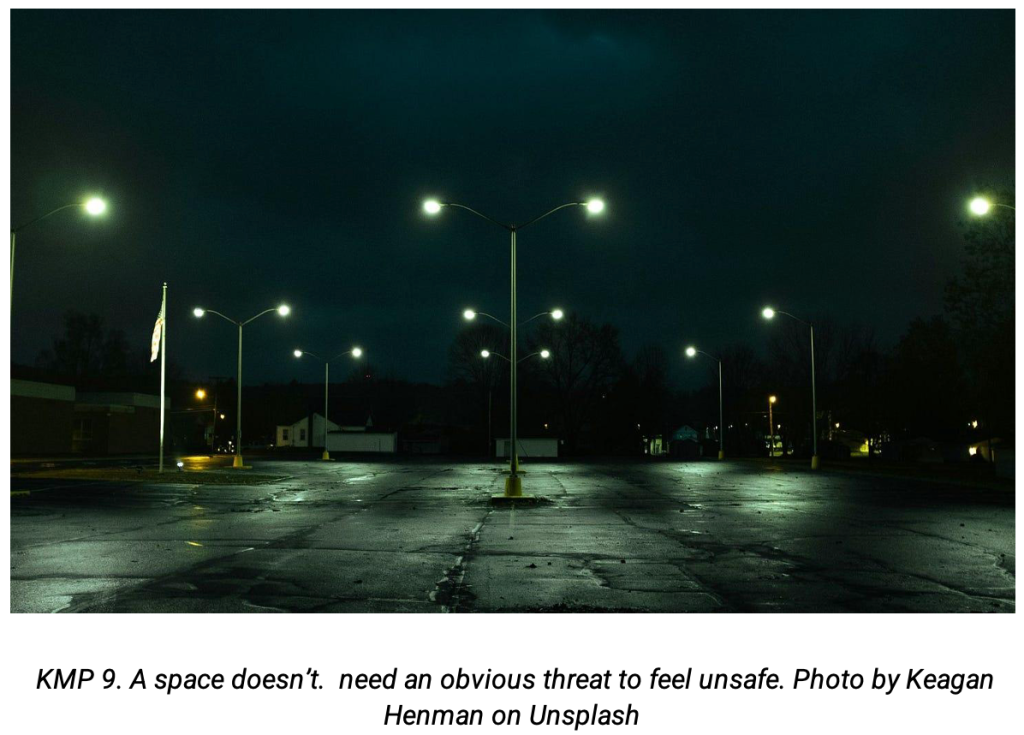
As mentioned earlier, a place can lose the thing people complain about and still fail to feel safe.
To determine how Kick it at Kellogg ultimately performed, measuring this distinction was essential. After all, the goal of the pilot was not simply to eliminate negative perceptions of the park, but to transform the park into a place where more people felt comfortable spending time.
But how do you measure that? Is it simply in the number of visitors?
Well, we found that the best measure is actual human behavior, and so some key indicators we tracked included:
- Who was visiting the park, and
- How often they returned
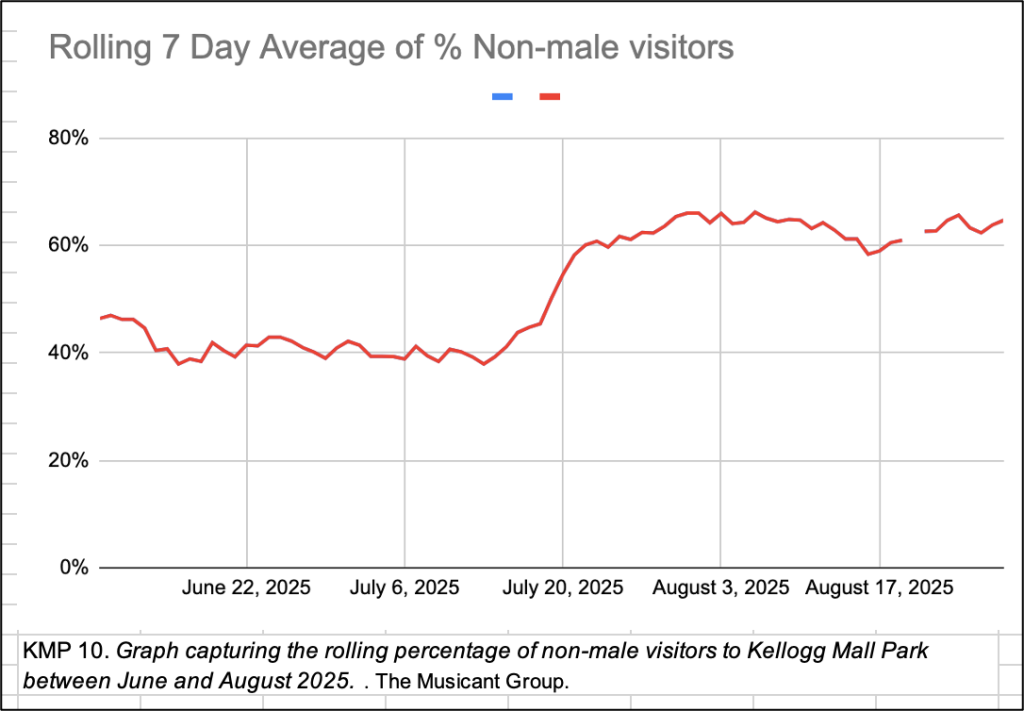 For example, we tracked the share of visitors who were women, children, and other non-male users as a proxy for perceived and actual safety. At the start of the pilot, non-male visitors accounted for roughly 40% of users, but by the end, that figure consistently exceeded 60%.
Interestingly, despite this positive shift, total visitation didn’t change much throughout the pilot period. What did change, however, was return visits. Survey respondents reported increasing their average visits from 7.6 times per month before the pilot to 12.4 times afterward. The median number of monthly visits rose even more dramatically, from just two visits per month to eleven.
If we had only considered total visitation, we would’ve probably concluded that our efforts didn’t produce much change. But these numbers tell a different story: the park was becoming part of people’s routines. More people who had previously been less likely to use the park were showing up, and the people who were using it were coming back more often.
“I never actually thought I would want to spend time in Kellogg Park or bring my grandkids there, which is sad because it is a gem of a park. We love all the downtown parks, but always spent the least time in Kellogg, but now if it continues on the path it is on, I look forward to spending more time there too.”
The Ecosystem of Safety
By most accounts, Kick It at Kellogg was a success. By orienting its goals around cultivation rather than elimination, we and the city were able to focus on the outcomes it actually wanted. But the pilot was never meant to produce a simple before-and-after verdict. Its value was in creating a feedback loop: What’s working? What isn’t? What deserves more investment? What needs to change?
We adjusted programming throughout the pilot based on what we observed. Some events attracted the participation we had hoped for while others didn’t. When an intervention fell short, rather than write it off as a failure, we used it to inform where resources could be better spent.
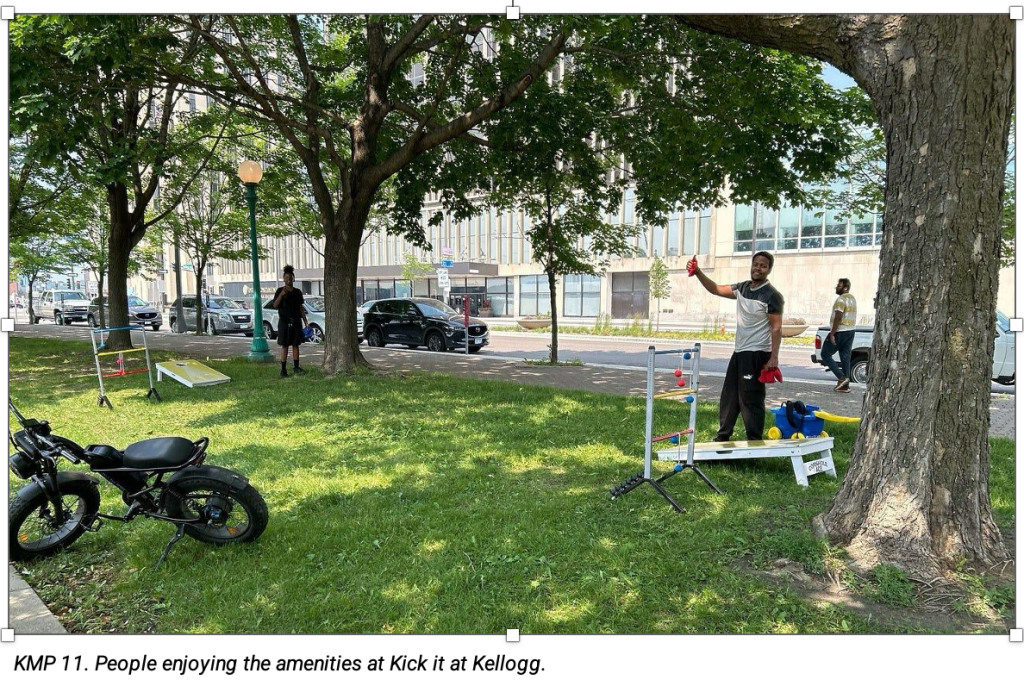 And then there were the interventions that far exceeded our expectations, like the park ambassadors. Survey respondents repeatedly identified them as crucial to their sense of comfort and safety–strong evidence that this was an area worth investing in further.
The pilot also surfaced challenges that required further attention. For example, the public restroom proved difficult to keep clean so, unfortunately, we had to remove it. Issues related to sanitation, maintenance, and scattered drug use continued to arise throughout the pilot period. Importantly, however, these challenges did not erase the program’s successes.
Instead, the pilot helped place them in context. It demonstrated that progress did not depend on eliminating every single problem before improvements could occur. People were using the park more often and reporting greater comfort even as some issues persisted.
Ultimately, what changed was not the complete absence of challenges, but the presence of conditions that made the park better despite them. People who had written off Kellogg for years were now visiting it weekly with their kids. That, on its own, marked a step in the right direction.
Photo Credits
KMP 1: Kellogg Mall Park. Photo by Anthony Eaton. https://espressotalks.com/2025/05/26/the-decaying-city-kellogg-mall-park/
KMP 2 to 6. Some photos taken during Kick it at Kellogg. The Musicant Group
KMP 7. Some of Kick it at Kellogg’s park ambassadors. The Musicant Group.
KMP 8. .: People enjoying the dog park at Kick it at Kellogg. The Musicant Group.
KMP 9. A space doesn’t. need an obvious threat to feel unsafe. Photo by Keagan Henman on Unsplashed https://unsplash.com/photos/road-lights-at-night-xRVEuJXVMH4?utm_source=unsplash&utm_medium=referral&utm_content=creditCopyText
KMP 10. Graph capturing the rolling percentage of non-male visitors to Kellogg Mall Park between June and August 2025. . The Musicant Group.
KMP 11.: People enjoying the amenities at Kick it at Kellogg. The Musicant Group.